Match Each Region With the Most Common Type of Native American Art Produced in That Region
Great Bowl Culture
The peoples of the Smashing Basin surface area required ease of mobility to follow bison herds and gather seasonally available food supplies.
Learning Objectives
Draw the culture of the Peachy Basin civilizations
Primal Takeaways
Key Points
- Between 10,500 BCE and 9,500 BCE (xi,500 – 12,500 years ago), the broad-spectrum, big game hunters of the Slap-up Plains began to focus on a single animate being species: the bison.
- Paleo-Indians were not numerous, and population densities were quite low during this time.
- These bison-oriented indigenous peoples inhabited a portion of the North American continent known as the Bully Bowl.
- The climate in the Bang-up Basin was very barren, which affected the lifestyles and cultures of its inhabitants.
Primal Terms
- cultural region: A cultural region is inhabited by a culture that does not limit their geographic coverage to the borders of a nation land, or to smaller subdivisions of a state.
- metates: A morter and grind stone tool used for processing grain and seeds.
- Numic languages: A co-operative of the Uto-Aztecan language family. Includes seven languages spoken by American Indian peoples traditionally living in the Great Basin, Colorado River Basin, and southern Great Plains.
Between ten,500 BCE and 9,500 BCE (11,500 – 12,500 years agone), the wide-spectrum, large game hunters of the Slap-up Plains began to focus on a single animal species: the bison, an early cousin of the American Bison. The primeval of these bison-oriented hunting traditions is known as the Folsom tradition. Folsom peoples traveled in small family unit groups for most of the year, returning yearly to the same springs while others favored locations on higher grounds. In that location they would camp for a few days, moving on after erecting a temporary shelter, making and/or repairing stone tools, or processing meat. Paleo-Indians were non numerous, and population densities were quite low during this time.
These bison-oriented ethnic peoples mostly inhabited a portion of the North American continent known as the "cultural region" of the Great Basin. The Peachy Basin is the region between the Rocky Mountains and the Sierra Nevada, in what is now modern-day Nevada, Utah, California, Idaho, Wyoming, and parts of Oregon. The original inhabitants of the region are believed to have arrived as early every bit 10,000 BCE. The climate in the Corking Basin was and is very arid; this affected the lifestyles and cultures of its inhabitants.

Map showing the Keen Basin: The Great Basin is a multi-state endorheic area surrounded past the Pacific Watershed of N America, home to the pre-Columbian indigenous peoples of the Great Basin.
Language
While anthropologists can signal to many distinct peoples throughout the region, most peoples of the Great Basin shared certain common cultural elements that distinguished them from other surrounding cultures. Except for the Washoe, almost of the groups spoke Numic languages. Some groups may have not have spoken Numic languages, but no relics of their linguistic patterns remain today. There was considerable intermingling among the groups, who lived peacefully and often shared common territories. These groups were all predominantly hunters and gatherers. As a outcome of these similarities, anthropologists utilize the terms "Desert Archaic" or more just "The Desert Culture" to refer collectively to the Great Bowl tribes.
Lifeways
Desert Archaic peoples required great mobility to follow seasonally available nutrient supplies. The use of pottery was rare because of its weight, simply intricate baskets were woven that could be used to concord water, cook food, and winnow grass seeds. Baskets were also used for storage, including the storage of pine basics. Heavy items such as metates were cached rather than carried between foraging areas. Agriculture was non practiced within the Great Basin itself, although it was skillful in adjacent areas. The area was too dry, and even mod agriculture in the Cracking Bowl requires either big mountain reservoirs or deep artesian wells. Likewise, the Great Basin tribes had no permanent settlements, although winter villages might exist revisited winter after winter by the same groups of families. In the summer groups would separate; the largest social grouping was usually the nuclear family, an efficient response to the depression density of food supplies.
Religion
Because Great Basin peoples did not come into contact with European-Americans or African Americans until comparatively afterwards in North American history, many groups were able to maintain their traditional tribal religions. These peoples were leading proponents of cultural and religious renewals during the 19th century. 2 Paiute prophets, Wodziwob and Wovoka, introduced the Ghost Dance as a means to commune with departed loved ones and bring renewals of buffalo herds and precontact lifeways. The Ute Bear Trip the light fantastic toe also emerged in the Great Basin, as did the Dominicus Trip the light fantastic.
Peyote religion flourished in the Groovy Basin every bit well, particularly amongst the Ute who used peyote obtained through trade and other potent ceremonial plants. Ute religious behavior borrowed heavily from Plains Indians afterward the arrival of the horse. Northern and Uncompahgre Ute were among the only group of ethnic peoples known to create ceremonial pipes out of salmon alabaster and rare black pipestone institute in creeks that edge the southeastern slops of the Uinta Mountains in Utah and Colorado. The Uncompahgre Ute are also among the first documented peoples to utilise the effect of mechanoluminescene with quartz crystals to generate light in ceremonies used to call spirits. Special ceremonial rattles were made from buffalo rawhide and filled with clear quartz crystals collected from the mountains of Colorado and Utah. These ceremonial rattles were considered extremely powerful religious objects.
Pacific Declension Culture
The mild climate and arable natural resources forth the Pacific Coast of Due north America allowed a complex ancient civilisation to flourish.
Learning Objectives
Examine how natural resources shaped the cultures of the Pacific Declension
Primal Takeaways
Cardinal Points
- Due to the prosperity fabricated possible by the arable natural resources in this region, the ethnic peoples of the Pacific Northwest developed complex religious and social ceremonies likewise equally many fine arts and crafts.
- Music was created to honor the Earth, the creator, ancestors, and all other aspects of the supernatural world.
- Many works of art served practical purposes, such as habiliment, tools, weapons of state of war and hunting, transportation, and shelter; but others were purely aesthetic.
- The Pacific Declension was at i fourth dimension the well-nigh densely populated area of North America in terms of ethnic peoples.
Key Terms
- permaculture: Whatever system of sustainable agronomics that renews natural resources and enriches local ecosystems.
- potlatch: A ceremony amongst sure American Indian peoples of the Pacific Declension in which gifts are bestowed upon guests and personal belongings is destroyed in a show of wealth and generosity.
- animism: The worldview that non-human entities—such as animals, plants, and inanimate
objects—possess a spiritual essence.
The indigenous peoples of the Pacific Northwest Declension were composed of many nations and tribal affiliations, each with distinctive cultural and political identities; but they shared sure behavior, traditions, and practices, such as the axis of salmon as a resource and spiritual symbol. These nations had time and energy to devote to the establishment of fine arts and crafts and to religious and social
ceremonies. The term "Northwest Declension", or "North West Coast", is used to refer to the groups of indigenous people residing along the coasts of British Columbia, Washington State, parts of Alaska, Oregon, and northern California.
The Pacific Northwest Coast at one time had the nigh densely populated areas of ethnic people. The balmy climate and abundant natural resources,
such as cedar and salmon, made possible the rise of a complex aboriginal civilization. The indigenous people in this region adept diverse forms of forest gardening and burn-stick farming in the forests, grasslands, mixed woodlands, and wetlands, ensuring that desired nutrient and medicine plats continued to exist bachelor through the use of advanced farming techniques. Those involved in agricultural development would create low-intensity fires in guild to prevent larger, catastrophic fires and sustain low-density agriculture in a loose rotation. This is what is known as permaculture, or any system of sustainable agronomics that renews natural resources and enriches local ecosystems.
Arts and crafts
I of the major cultural elements that began to flourish on the Pacific Northwest Coast was the apply of music and other forms of arts and crafts. Although music varied in role and expression among indigenous tribes, there were cultural similarities. For example, some tribes used hand drums made of animal hides every bit their instrument of choice, while others used plank or log drums, forth with whistlers, wood clappers, and rattles. However, regardless of the type of musical instrument used, music and song were created to accompany ceremonies, dancing, and festivities.
The principal function of music in this region was to invoke spirituality. Music was created to laurels the Globe, the creator, ancestors, and all other aspects of the supernatural earth. Songs were besides used to convey stories and sometimes were owned by families like property that could be inherited, sold, or given as a gift to a prestigious guest at a banquet. Professional musicians existed in some communities, and in some nations, those who made musical errors were punished, usually through shaming. Song rhythmic patterns were ofttimes complex and ran counter to rigid percussion beats.
As with music, the creation of art also served as a ways of transmitting stories, history, wisdom, and property from generation to generation. Due to the abundance of natural resources and the affluence of virtually Northwest tribes, there was plenty of leisure fourth dimension to create art. Many works of art served practical purposes, such equally clothing, tools, weapons of war and hunting, transportation, cooking, and shelter. Others were purely artful. Art provided indigenous people with a necktie to the land and was a constant reminder of their birth places, lineages, and nations. One instance of this is the use of symbols on totem poles and plank houses of the Pacific Northwest coast.
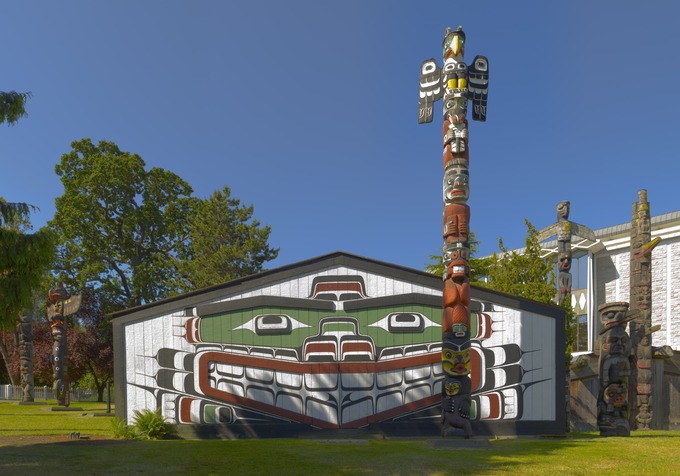
Pacific Coast Art: Tribal fine art included plank houses and totem poles that served as abiding reminders of ethnic peoples' birth places, lineages, and nations.
Religious and Social Ceremonies
Other cultural elements that became established were the religious and social ceremonies of the Pacific Northwest nations. Although various tribes might have had their ain dissimilar mythologies and rituals, "animism" is said to describe the most common, foundational thread of indigenous peoples'
spiritual or supernatural perspectives in this region. Spiritualism, the supernatural, and the importance of the environment played such integral roles in day-to-24-hour interval life. Therefore, it was non unusual for worldly goods to be adorned with symbols, crests, and totems that represented some of import figure(s) from both the seen and unseen worlds.
Many of these religious or spiritual symbols would exist nowadays during social ceremonies also. The potlatch, a gift-giving feast, was mayhap i of the most significant social experiences that occurred within Pacific Northwest groups. It was a highly complex consequence where people gathered in order to commemorate a specific event such as the raising of a totem pole or the engagement/ballot of a new master. In the potlatch anniversary, the chief would requite highly elaborate gifts to visiting peoples in order to plant his power and prestige, and by accepting these gifts, the visitors conveyed their approval of the chief. There were also peachy feasts and displays of conspicuous consumption. Groups of dancers put on elaborate dances and ceremonies. Watching these performances was considered an laurels. Potlatches were held for several reasons: the confirmation of a new primary, coming of historic period, tattooing or piercing ceremonies, initiation into a secret gild, marriages, the funeral of a chief, or a boxing victory.
Eastern Woodland Culture
Eastern Woodland Civilisation refers to the style of life of indigenous peoples in the eastern office of Due north America betwixt 1,000 BCE and 1,000 CE.
Learning Objectives
Clarify how agronomical practices shaped the Eastern Woodland Culture
Key Takeaways
Cardinal Points
- This fourth dimension period is widely regarded as a developmental flow for the people of this region as they steadily advanced in their ways of cultivation, tools and textile manufacture, and use of pottery.
- While the increasing use of agriculture meant the nomadic nature of many groups was supplanted by permanent villages, intensive agriculture did not become the norm for almost cultures until the succeeding Mississippian menses.
- The Early Woodland period differed from the Archaic period in the following ways: the advent of permanent settlements, elaborate burying practices, intensive collection and horticulture of starchy seed plants, differentiation in social organization, and specialized activities.
- Due to the similarity of earthworks and burying goods, researchers presume a common body of religious practice and cultural interaction existed throughout the entire region, referred to as the "Hopewellian Interaction Sphere."
Key Terms
- maize: A grain, domesticated by indigenous peoples in Mesoamerica in prehistoric times, known in many English language-speaking countries equally corn.
- atlatl: A wooden stick with a thong or perpendicularly protruding hook on the rear stop that grips a grove or socket on the butt of its accompanying spear.
The Eastern Woodland cultural region extended from what is now southeastern Canada, through the eastern Usa, downwards to the Gulf of Mexico. The time in which the peoples of this region flourished is referred to as the Woodland Period. This catamenia is known for its continuous development in stone and os tools, leather crafting, textile industry, tillage, and shelter structure. Many Woodland hunters used spears and atlatls until the end of the period when those were replaced past bows and arrows. The Southeastern Woodland hunters however, besides used blowguns. The major technological and cultural advancements during this catamenia included the widespread apply of pottery and the increasing sophistication of its forms and decoration. The growing use of agronomics and the development of the Eastern Agronomical Complex as well meant that the nomadic nature of many of the groups was supplanted by permanently occupied villages.
Early Woodland Period (1000–1 BCE)
The archaeological tape suggests that humans in the Eastern Woodlands of North America were collecting plants from the wild past 6,000 BCE and gradually modifying them by selective collection and cultivation. In fact, the eastern Usa is one of 10 regions in the world to become an "independent center of agricultural origin." Research besides indicates that the starting time appearance of ceramics occurred effectually 2,500 BCE in parts of Florida and Georgia. What differentiates the Early Woodland menses from the Archaic menses is the appearance of permanent settlements, elaborate burial practices, intensive collection and horticulture of starchy seed plants, and differentiation in social organization. Most of these were evident in the southeastern The states past 1,000 BCE with the Adena culture, which is the best-known example of an early Woodland civilization.
The Adena civilization was centered around what is nowadays-solar day Ohio and surrounding states and was most probable a number of related American Indian societies that shared burial complexes and ceremonial systems. Adena mounds mostly ranged in size from 2o to 300 feet in diameter and served every bit burial structures, ceremonial sites, historical markers, and maybe even gathering places. The mounds provided a fixed geographical reference point for the scattered populations of people dispersed in small settlements of one to two structures. A typical Adena business firm was congenital in a circular grade, 15 to 45 feet in diameter. Walls were made of paired posts tilted outward that were then joined to other pieces of forest to form a cone-shaped roof. The roof was covered with bawl, and the walls were bark and/or wickerwork.
While the burying mounds created by Woodland culture peoples were cute artistic achievements, Adena artists were also prolific in creating smaller, more personal pieces of fine art using copper and shells. Art motifs that became of import to many after American Indians began with the Adena. Examples of these motifs include the weeping centre and the cantankerous and circle blueprint. Many works of art revolved effectually shamanic practices and the transformation of humans into animals, specially birds, wolves, bears, and deer, indicating a belief that objects depicting certain animals could impart those animals' qualities to the wearer or holder.
Middle Woodland Catamenia (1–500 CE)
The beginning of this period saw a shift of settlement to the interior. As the Woodland menstruum progressed, local and inter-regional merchandise of exotic materials greatly increased to the point where a trade network covered nearly of the eastern The states. Throughout the Southeast and north of the Ohio River, burying mounds of important people were very elaborate and independent a variety of mortuary gifts, many of which were not local. The most archaeologically certifiable sites of burial during this time were in Illinois and Ohio. These have come up to exist known as the Hopewell tradition.

Hopewell mounds: The Eastern Woodland cultures built burial mounds for important people such as these of the Hopewell tradition in Ohio.
The Hopewellian peoples had leaders, merely they were not powerful rulers who could command armies of soldiers or slaves. It has been posited that these cultures accorded certain families with special privileges and that these societies were marked by the emergence of "big-men," or leaders who were able to acquire positions of power through their power to persuade others to agree with them on matters of trade and organized religion. It is besides probable these rulers gained influence through the creation of reciprocal obligations with other important community members. Regardless of their path to ability, the emergence of big-men marked another step toward the development of the highly structured and stratified sociopolitical arrangement called the chiefdom, which would narrate afterward American Indian tribes. Due to the similarity of earthworks and burial goods, researchers presume a common body of religious practice and cultural interaction existed throughout the entire region (referred to as the "Hopewellian Interaction Sphere"). Such similarities could besides be the effect of reciprocal merchandise, obligations, or both between local clans that controlled specific territories. Clan heads were buried along with goods received from their trading partners to symbolize the relationships they had established. Although many of the Middle Woodland cultures are called Hopewellian, and groups shared formalism practices, archaeologists accept identified the development of distinctly separate cultures during the Middle Woodland period. Examples include the Armstrong culture, Copena culture, Crab Orchard culture, Fourche Maline culture, the Goodall Focus, the Havana Hopewell culture, the Kansas City Hopewell, the Marksville culture, and the Swift Creek culture.

Hopewell Interaction Area and local expressions of the Hopewell tradition: Throughout the Southeast and north of the Ohio River, burial mounds of important people were very elaborate and contained a multifariousness of mortuary gifts, many of which were not local. The most archaeologically certifiable sites of burial during this time were in Illinois and Ohio. These sites were constructed within the Hopewell tradition of Eastern Woodland cultures.
Ceramics during this time were thinner, of better quality, and more decorated than in before times. This ceramic stage saw a trend towards round-bodied pottery and lines of ornament with cantankerous-etching on the rims.
Belatedly Woodland Period (500–chiliad CE)
The late Woodland period was a time of apparent population dispersal. In well-nigh areas, structure of burial mounds decreased drastically, as did long distance trade in exotic materials. Bow and arrow technology gradually overtook the use of the spear and atlatl, and agricultural output of the "three sisters" (maize, beans, and squash) was introduced. While full scale intensive agriculture did non begin until the following Mississippian period, the beginning of serious cultivation profoundly supplemented the gathering of plants.
Late Woodland settlements became more numerous, but the size of each one was generally smaller than their Middle Woodland counterparts. It has been theorized that populations increased and so much that trade alone could no longer back up the communities and some clans resorted to raiding others for resource. Alternatively, the efficiency of bows and arrows in hunting may have decimated the big game animals, forcing tribes to suspension apart into smaller clans to better use local resource, thus limiting the trade potential of each grouping. A third possibility is that a colder climate may have afflicted food yields, also limiting trade possibilities. Lastly, it may be that agronomical technology became sophisticated plenty that ingather variation between clans lessened, thereby decreasing the need for trade.
In practise, many regions of the Eastern Woodlands adopted the full Mississippian civilization much later than 1,000 CE. Some groups in the N and Northeast of the United States, such as the Iroquois, retained a fashion of life that was technologically identical to the Tardily Woodland until the inflow of the Europeans. Furthermore, despite the widespread adoption of the bow and arrow, indigenous peoples in areas near the mouth of the Mississippi River, for example, announced never to take made the change.
Southwestern Civilisation
Environmental changes allowed for many cultural traditions to
flourish and develop like social structures and religious beliefs.
Learning Objectives
Draw the cultural traditions of the Southwest
Primal Points
- 3 of the major cultural traditions that impacted the region include the Paleo-Indian tradition, the Southwestern Primitive tradition, and the Post-Archaic cultures tradition.
- Every bit Southwestern cultural traditions evolved, tribes transitioned from a hunting-gathering, nomadic experience to more permanent agricultural settlements.
- As various cultures developed over time, many shared similarities in family structure and religious beliefs.
- Extensive irrigation systems were adult and were among the largest of the ancient earth.
- Elaborate adobe and sandstone buildings were synthetic, and highly ornamental and artistic pottery was created.
Primal Terms
- animism: The worldview that non-homo entities—such every bit animals, plants, and inanimate objects—possess a spiritual essence.
- sandstone: A sedimentary rock produced by the consolidation and compaction of sand, cemented with clay.
- irrigation: The act or process of irrigating, or the state of being irrigated; particularly, the functioning of causing water to catamenia over lands for the purpose of nourishing plants.
- shamanism: A exercise that involves a practitioner reaching altered states of consciousness in order to perceive and interact with a spirit earth and channel transcendental energies into this earth.
Overview
The greater Southwest has long been occupied by hunter-gatherers and agronomical settlements. This expanse, comprised of modern-twenty-four hour period Colorado, Arizona, New United mexican states, Utah, and Nevada, and usa of Sonora and Chihuahua in northern Mexico, has seen successive prehistoric cultural traditions since approximately 12,000 years ago. Iii of the major cultural traditions that impacted the region include the Paleo-Indian tradition, the Southwestern Archaic tradition, and the Post-Archaic cultures tradition. Equally diverse cultures developed over time, many of them shared similarities in family unit structure and religious beliefs.
Southwestern Agriculture
Southwestern farmers probably began experimenting with agriculture past facilitating the growth of wild grains such as amaranth and chenopods as well as gourds for their edible seeds and shells. The earliest maize known to take been grown in the Southwest was a popcorn varietal measuring i to ii inches long. It was not a very productive ingather. More productive varieties were adult later on by Southwestern farmers or introduced via Mesoamerica, though the drought-resistant tepary edible bean was native to the region. Cotton fiber has been found at archaeological sites dating to about 1,200 BCE in the Tucson basin and was almost probable cultivated by indigenous peoples in the region. Evidence of tobacco use and possibly the cultivation of tobacco, dates back to approximately the same time menstruation.
Agave, peculiarly agave murpheyi, was a major nutrient source of the Hohokam and grown on dry out hillsides where other crops would not grow. Early farmers also possibly cultivated cactus fruit, mesquite edible bean, and species of wild grasses for their edible seeds.
Paleolithic peoples utilized habitats near h2o sources like rivers, swamps, and marshes, which had an affluence of fish and attracted birds and game animals. They hunted big game—bison, mammoths, and ground sloths—who were also attracted to these water sources. A period of relatively wet conditions saw many cultures in the American Southwest flourish. Extensive irrigation systems were developed and were among the largest of the ancient world. Elaborate adobe and sandstone buildings were constructed, and highly ornamental and creative pottery was created. The unusual conditions atmospheric condition could not continue forever, however, and gave way in time, to the more than mutual arid atmospheric condition of the area. These dry weather condition necessitated a more than minimal style of life and, eventually, the elaborate accomplishments of these cultures were abandoned.
During this fourth dimension, the people of the Southwest developed a variety of subsistence strategies, all using their own specific techniques. The nutritive value of weed and grass seeds was discovered and flat rocks were used to grind flour to produce gruels and breads. The apply of grinding slabs originated around seven,500 BCE and marks the beginning of the Primitive tradition. Small-scale bands of people traveled throughout the expanse gathering plants such equally cactus fruits, mesquite beans, acorns, and pine nuts. Archaic people established camps at collection points, and returned to these places twelvemonth subsequently year.
The American Indian Archaic civilization somewhen evolved into two major prehistoric archaeological culture areas in the American Southwest and northern Mexico. These cultures, sometimes referred to equally Oasisamerica, are characterized past dependence on agriculture, formal social stratification, population clusters, and major architecture. I of the major cultures that developed during this fourth dimension was the Pueblo peoples, formerly referred to as the Anasazi. Their distinctive pottery and dwelling construction styles emerged in the area around 750 CE. Ancestral Pueblo peoples are renowned for the construction of and cultural achievement present at Pueblo Bonito and other sites in Chaco Coulee, as well as Mesa Verde, Aztec Ruins, and Salmon Ruins. Other cultural traditions that developed during this time include the Hohokam and Mogollon traditions.

Hohokam Business firm: Photograph of the Great Business firm at the Casa Grande Ruins National Monument.
Family and Religion
Paleolithic peoples in the Southwest initially structured their families and communities into highly mobile traveling groups of approximately xx to fifty members, moving place to place as resources were depleted and additional supplies were needed. Every bit cultural traditions began to evolve throughout the Southwest between vii,500 BCE to 1,550 CE, many cultures developed like social and religious traditions. For the Pueblos and other Southwest American Indian communities, the transition from a hunting-gathering, nomadic experience to more permanent agricultural settlements meant more firmly established families and communities. Climate modify that occurred most iii,500 years ago during the Archaic period, all the same, changed patterns in h2o sources, dramatically decreasing the population of indigenous peoples. Many family-based groups took shelter in caves and stone overhangs within canyon walls, many of which faced s to capitalize on warmth from the lord's day during the wintertime. Occasionally, these peoples lived in small, semi-sedentary hamlets in open areas.
Many Southwest tribes during the Post-Archaic period lived in a range of structures that included pocket-sized family pit houses, larger structures to house clans, grand pueblos, and cliff-sited dwellings for defense. These communities adult complex networks that stretched across the Colorado Plateau, linking hundreds of neighborhoods and population centers.
While southwestern tribes developed more than permanent family structures and established complex communities, they also developed and shared a similar understanding of the spiritual and natural world. Many of the tribes that made up the Southwest Culture practiced animism and shamanism. Shamanism encompasses the premise that shamans are intermediaries or messengers between the man world and the spirit worlds. At the aforementioned time, animism encompasses the beliefs that in that location is no separation between the spiritual and physical (or cloth) globe, and that souls or spirits exist not but in humans, simply likewise in another animals, plants, rocks, and geographic features such as mountains or rivers, or other entities of the natural environment, including thunder, wind, and shadows.
Conclusion
Although now in that location are a diversity of contemporary cultural traditions that exist in the greater Southwest, many of these traditions even so comprise similar religious aspects that are establish in animism and shamanism. Some of these cultural traditions include the Yuman-speaking peoples inhabiting the Colorado River valley, the uplands, and Baja California; O'odham peoples of southern Arizona and northern Sonora; and the Pueblo peoples of Arizona and New Mexico.
Mississippian Culture
Mississippian cultures lived in the modernistic-day United states in the Mississippi valley from 800 to 1540.
Learning Objectives
Depict the economies of Mississippian cultures
Key Takeaways
Cardinal Points
- Mississippian cultures lived in the Mississippi valley, Ohio, Oklahoma, and surrounding areas.
- The "iii sisters"- corn, squash, and beans- were the three virtually of import crops.
- Spanish explorer Hernando de Soto brought diseases and cultural changes that eventually contributed to the refuse of many Mississippian cultures.
Central Terms
- iii sisters: Corn, squash, and beans. The 3 most of import crops for Mississippian cultures.
- mounds: Formations made of globe that were used as foundations for Mississippian civilization structures.
The Mississippian Catamenia lasted from approximately 800 to 1540 CE. Information technology'south chosen "Mississippian" because information technology began in the middle Mississippi River valley, betwixt St. Louis and Vicksburg. However, in that location were other Mississippians as the culture spread across modern-day US. There were large Mississippian centers in Missouri, Ohio, and Oklahoma.
A number of cultural traits are recognized as being characteristic of the Mississippians. Although not all Mississippian peoples practiced all of the following activities, they were distinct from their ancestors in adoption of some or all of the post-obit traits:
- The construction of large, truncated earthwork pyramid mounds, or platform mounds. Such mounds were usually square, rectangular, or occasionally circular. Structures (domestic houses, temples, burial buildings, or other) were usually constructed atop such mounds.
- Maize-based agriculture. In almost places, the development of Mississippian civilisation coincided with adoption of insufficiently large-scale, intensive maize agriculture, which supported larger populations and arts and crafts specialization.
- The adoption and use of riverine (or more rarely marine) shells as tempering agents in their trounce tempered pottery.
- Widespread trade networks extending as far westward every bit the Rockies, northward to the Great Lakes, south to the Gulf of United mexican states, and east to the Atlantic Ocean.
- The development of the chiefdom or circuitous chiefdom level of social complexity.
- A centralization of command of combined political and religious ability in the hands of few or one.
- The beginnings of a settlement hierarchy, in which ane major eye (with mounds) has articulate influence or control over a number of bottom communities, which may or may not possess a smaller number of mounds.
- The adoption of the paraphernalia of the Southeastern Formalism Complex (SECC), as well called the Southern Cult. This is the belief organisation of the Mississippians as we know it. SECC items are institute in Mississippian-culture sites from Wisconsin to the Gulf Coast, and from Florida to Arkansas and Oklahoma. The SECC was frequently tied in to ritual game-playing.

Mississippian Cultures: There were a number of Mississippian cultures, with most spreading from the Centre Mississippian area.
Although hunting and gathering plants for food was still important, the Mississippians were mainly farmers. They grew corn, beans, and squash, called the "three sisters" past historic Southeastern Indians. The "sisters" provided a stable and counterbalanced nutrition, making a larger population possible. Thousands of people lived in some larger towns and cities.
A typical Mississipian town was built near a river or creek. Information technology covered near ten acres of ground, and was surrounded past a palisade, a fence fabricated of wooden poles placed upright in the ground. A typical Mississippian firm was rectangular, nearly 12 feet long and 10 feet wide. The walls of a firm were built by placing wooden poles upright in a trench in the ground. The poles were then covered with a woven cane matting. The cane matting was so covered with plaster fabricated from mud. This plastered cane matting is called "wattle and daub". The roof of the business firm was made from a steep "A" shaped framework of wooden poles covered with grass woven into a tight thatch.

Platform Mounds: Mississippian cultures oftentimes built structures on top of their mounds such as homes and burial buildings.
Mississippian cultures, like many before them, congenital mounds. Though other cultures may accept used mounds for dissimilar purposes, Mississippian cultures typically built structures on top of them. The blazon of structures constructed ran the gamut: temples, houses, and burial buildings.
Mississippian artists produced unique art works. They engraved shell pendants with fauna and human being figures, and carved ceremonial objects out of flintstone. They sculpted human figures and other objects in stone. Potters molded their dirt into many shapes, sometimes decorating them with painted designs.
.jpeg#fixme)
Mississippian Underwater Panther
The Nashville expanse was a major population center during this menstruum. Thousands of Mississippian-era graves take been found in the metropolis, and thousands more may be in the surrounding expanse. At that place were once many temple and burial mounds in Nashville, specially along the Cumberland River.
Decline of the Mississippians
Hernando de Soto was a Spanish explorer who, from 1539-43, lived with and spoke to many Mississippian cultures. Afterward his contact, their cultures were relatively unaffected directly by Europeans, though they were indirectly. Since the natives lacked immunity to new infectious diseases, such every bit measles and smallpox, epidemics caused so many fatalities that they undermined the social order of many chiefdoms. Some groups adopted European horses and changed to nomadism. Political structures complanate in many places.By the time more documentary accounts were being written, the Mississippian way of life had changed irrevocably. Some groups maintained an oral tradition link to their mound-edifice past, such equally the late 19th-century Cherokee. Other Native American groups, having migrated many hundreds of miles and lost their elders to diseases, did not know their ancestors had congenital the mounds dotting the landscape. This contributed to the myth of the Mound Builders as a people distinct from Native Americans.

Hernando de Soto: Engraving past Lambert A. Wilmer (1858)
Mississippian peoples were almost certainly ancestral to the majority of the American Indian nations living in this region in the celebrated era. The celebrated and modern mean solar day American Indian nations believed to accept descended from the overarching Mississippian Culture include: the Alabama, Apalachee, Caddo, Cherokee, Chickasaw, Choctaw, Muscogee Creek, Guale, Hitchiti, Houma, Kansa, Missouria, Mobilian, Natchez, Osage, Quapaw, Seminole, Tunica-Biloxi, Yamasee, and Yuchi.
Source: https://courses.lumenlearning.com/boundless-worldhistory/chapter/native-american-cultures-in-north-america/
0 Response to "Match Each Region With the Most Common Type of Native American Art Produced in That Region"
Post a Comment